Full Transcript — Dr. Mikayel Grigoryan neurosurgeon on Stroke, the Armenian Community and What Doctors Don't Say Out Loud | INSIGHT Podcast

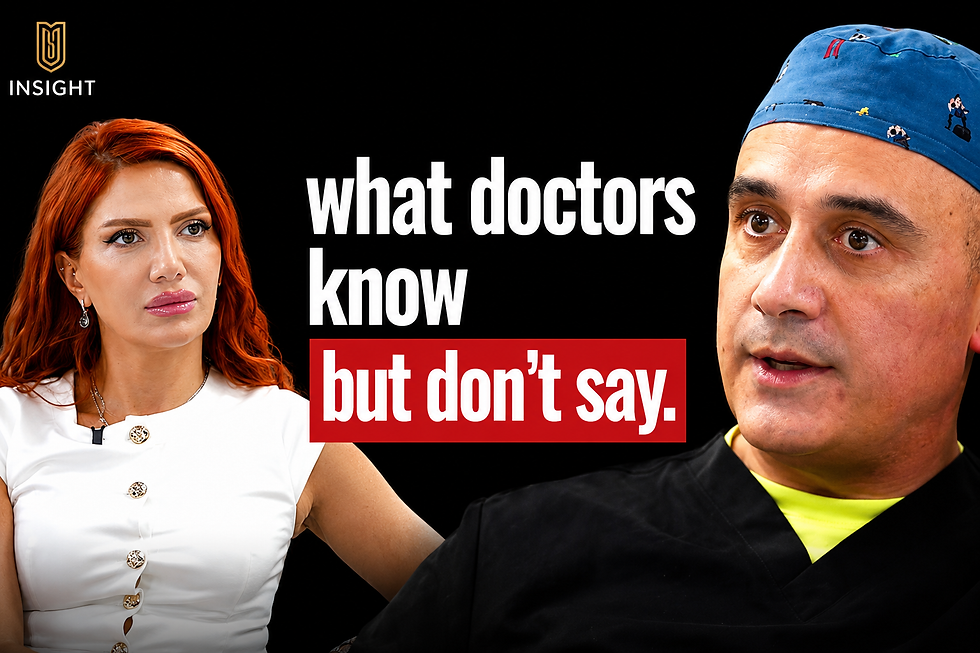
In this episode of INSIGHT, Emma Sargsyan sits down with Dr. Mikayel Grigoryan — Medical Director of the Neurointerventional Program at Adventist Health Glendale — for the most honest medical conversation she has ever filmed. Below is the full transcript of their conversation
Every 3 seconds, someone in the world has a stroke. In the next 1 hour or so, while you are going to watch this interview, 1,200 people are going to have one. A lot of people think that a stroke is something that happens to old people. They will see it coming. It is something slow. But actually, [music] it's not. And what happens when you have a stroke until the moment when they reverse you back to life? That window is very, very little. It's measured in minutes. My guest today goes into that window. But before I take you to the interview with Dr. Mikuel Gregorian, [music] I have a request to you. Please follow me on YouTube, on Instagram, and on all other social media platforms not to miss any episode of Insight. Thank you. Let's go.
Dr. Thank you very much for being here today. Before Thank you for having me. Before we start about everything else, I want to know what it's actually like to be inside the brain of someone else. A catheter thinner than a hair is navigating through through the blood vessels. What do you feel at that moment? What what what does it look like?
I think the same thing that somebody feels when they love climbing mountains and they climb a mountain. They feel the energy rush. It's just it's a special feeling. It's fun. It's fun. Yes. It's a lot of fun. Knowing that the life of someone depends on your movement and one wrong movement is going to cost them. Precisely. That that's the fun. Everybody in their life does what gives them joy, what gives them the adrenaline rush. Such an old word, adrenaline. uh anyway uh and that that's what happens that's what it gives me that's why I do it when you when you are doing the surgery on the brain and like I mentioned you're navigating climbing the mountain you are dealing with a person's memories who they are the life that they have the love to their children have you actually are or are you actually thinking about that at the moment like this is not my profession this is not a brand this is not a tissue in front of me. This is someone's whole life that I'm doing it. And Dr. Mikayel Grigoryan neurosurgeon, have you actually thinking are you thinking about that when you are operating on a patient or or not? What do you think about I think about uh so it's it's really simple if you can simplify what we do. It's a either a vessel that needs to be opened up or an side of the vessel or a pocket of the vessel that needs to be shut down. uh because this person had a problem because of a blockage of a vessel or because of a leakage of the vessel. And what you focus on is exactly the same thing a plumber focuses on when they need to fix the pipe. They either need to open the pipe or they need to shut down a leaking pipe. And that's what you try to focus on. Of course, you think if you think too much about the psychological aspects of that, I think you're going to deviate from the mission. And the mission is to do exactly that to restore the memories, the you know feelings, the the movement, the speech etc etc. I have seen some videos I don't know if they're exaggerated or not when the patient is fully awake while the surgery is going on and he either like plays the violin or something else. Oh,
what is happening at that time? You need to know which part of the brain is functioning, how to operate, what is happening at that moment because it is emotional video. When you look at first, it's like, wow, look what's happening. But deep inside, you know that there's something phenomenal going on in there. What is that phenomenon? So, those are done really to this those are just commercials. No, they're real. But uh it's one out of a thousand probably that can be done that way and they are just done to to show that in certain scenarios things like that are possible. the routine uh operations surgeries are done uh under anesthesia and people are not fully awake because when they're fully awake especially my line of work because when you deal with millimeters when you deal with vessels any movement is a wrong movement for the doctor any movement of the patient is the wrong movement by the doctor inside the vessel and those vessels are very unforgiving so you they usually are asleep that said there are certain open surgeries which allow allow the patient to do carry out certain functions and they are done awake purposefully so in case the patient cannot do something they know that they are in the wrong part of the brain do you listen to the music in the surgery absolutely what what do you listen to I have playlist for every single type of uh procedure okay or is patients preference if patients awake if patients awake okay but very different music Dr. Mikayel Grigoryan I want to ask you something that Um many people get wrong. They think that stroke is something that happens to old people or it's going to arrive very slowly. I will know it when it happens. Dr. Mikayel Grigoryan neurosurgeon you have been in the area for 25 years. You have been there and you have seen so many cases of uh patients with stroke. What are the first and the foremost indicators that something is going wrong with the patient? How do you know or how should the patient I mean you you will know but how should the patient know that okay this is not something regular I need to go to the ER right now to answer your question sequentially stroke happens to can happen to anyone uh stroke happens suddenly and not gradually and there are telltale signs of stroke we try to make it simpler for general public for example we use acronyms there is an acronym called be Fast, be fast, which also implies that you need to be fast when you recognize the symptoms of stroke. But it contains most of the symptoms of stroke. B stands for balance, E stands for eyes, F stands for face, A stands for arm, S stands for speech and T stands for time, meaning you got to run. Everything has been affected. If any of them ah okay get affected suddenly. balance, vision, speech, facial droop, arm weakness, then you need to act immediately because treatments for stroke are very time-sensitive. And if you arrive too late, it's very similar to firefighting. If there is a fire on your property and you call the firefighter when the fire already burned through the forest, there is nothing. Yes, I can extinguish the fire, but it's not going to bring back your house. Mhm. If you call firefighter early, the property can be saved. But then you are saying that it arrives suddenly. How do how do how does one manage to to recognize that somebody needs to Well, it depends. Sometimes you yourself, God forbid, can recognize your own stroke symptoms and call 911 or just press the button. uh hopefully in the future not hopefully for sure there will be devices that will sense these things and notify uh the uh paramedics right away or somebody can witness them and that's why we spend so much time teaching educating general public about the warning signs and symptoms of stroke I was at one of the events where you were a panelist that that's where we uh actually met and you were mentioning about the AI in all all these procedures like recognizing up to treating. Can you elaborate more on how we can use or not not with the medicine can use the AI to early recognition then treating and and and so yes absolutely. So when it comes to for for example paramedics are picking up a patient uh first of all AI recognize the symptoms and uh even even the watch recognizing irregular heartbeats in a way that's artificial intelligence because it takes certain degree of intelligence to sense the rhythm through the skin recognize that somebody for example has irregular heartbeats uh then when the paramedics pick up the patient AI can decide cypher and uh transcribe all the conversation that happens between the paramedics and the family so that nothing gets lost in translation that all gets recorded on an app. Then when the paramedics talk to emergency room department that confirmation uh conversation gets recorded and the AI picks the important pieces which in case of a stroke are time of onset when was the last patient known seem well what exactly are symptoms what medications are the patient on and construct the prediction of what's going to what happened to the patient and offer treatments. Furthermore AI can provide all the literature. Let's say it's a dubious case. It's a case where you're not sure whether you should intervene or not because the evidence is not there yet. The AI automatically pops up. Here's all the articles and even make a suggestion. You should operate and you should not operate. In the remote areas of the world, there are actually robots that can you can remotely perform surgery, but it's very boring. And I hope that takes off when I'm already gone because the the not operating with your own hands is really boring and having somebody else. But for remote areas where there is no availability of physicians, that's actually a very uh good thing uh to consider. You have seen thousands of stroke cases. You know the patterns who survives, who's likely to fully recover, who's likely not to uh recover. You know what the research says and what the research does not say because you have around 45 uh peer-reviewed articles of yourself. What you know from 25 years of being inside this what the medical system what what is it that the medical system does not want us to know or doesn't say out loud not because it's bad or it's good but because it's convenient or it will take a lot of time to explain to the patient or it's just inconvenient. They just don't want the patient to know that. What is it about the stroke? I think the well so it's the medical system is wrong in one thing. It rewards physicians for quantity of care never for quality of care. Those the only way to make money in medicine is to be efficient. Nobody cares. There is no such thing. They talk about you will hear a lot about those words value based care. There's no such thing practically valuebased care. insuranceances pay hospitals, physicians based on speed and efficiency. Mhm. So the system, it's not that the system doesn't want it. Everything is a business for better or for worse, unfortunately or fortunately. And therefore, everything needs to meet its thresholds. So it's very difficult and physicians are frequently perceived as careless or insensitive because they are forced by the system to be quick and efficient not because they don't want to sit down and spend time and talk with you. So that is the biggest flow as I see fundamentally in this entire system. How does it affect the patient? patients feel under underappreciated, under uh valued. Uh they feel like they went through a meat packing facility instead of having a conversation with a physician. And then they go online and leave negative reviews for the physician, which you know is mind-blowing because I don't think physicians should be reviewed. But that's the biggest problem because we're not restaurants. We should not have reviews. Uh it's that's just my humble opinion. Uh at least online in public, you know, similar to a restaurant like Google, you know, there are physician reviews for on Google about physicians because frequently you never get a chance to respond to that and never get a chance to offer your point of view as to why things happen. I'm not trying to say that there are no bad physicians. Of course there are. But it's sort of a it puts you into real of a customer service provider as opposed to what we truly went to medical school for. We went to medical school to help people get fixed first and foremost. This is what drives us. This is our passion. Not provide some sort of customer service. So expectations that were unfairly not met turn into bad reviews about the people who have saved their lives. It's not just that. I mean I understand when the review goes directly against the physician for whatever reason. But more often than not, and you probably know that somebody would write something like, "Oh, I broke up in the office of phys this physician. and I broke up with my boyfriend and that's why I'm rating this position one star. Okay, I I fail to understand the connection between one and the other but things like that happen or it's insurance didn't pay uh this and doctor sent me the bill that's why I rate this is not neither is the fault has nothing to do with you we don't work to get good reviews online we work to save patients we don't even have time to respond and offer our point of view to that and I'm not trying to you know complain this is life but this is I think one of the flaws of the system basically does it affect you somehow negative reviews or something depends I mean if they are substantiate not that I had many to begin I mean people don't review me as much as they review office physicians because my work is mostly in hospital and I guess I'm uh grateful for that because I deal with emergencies uh people can leave reviews that are completely they didn't they have never even seen the doctor and they can of course they would affect anybody because unfortunately when people choose where to go see we became physicians became a a product in a way you choose that's why I actually like that I work in an emergent line emer that I you know people don't get to pick and choose too much there of course there are there's an elective part of the business and the emergent part but I love the emergency services because it's completely non-denominational. You are open to receive anybody and you're giving everybody a fair chance of recovery and that's really also gives you adrenal rush and everything. But when you're an office doctor, people really pick and choose. And I guess you can argue that that's the right thing to do because if you need a doctor, you want to go to the doctor that has the best reviews. And how do you know objectively? You can ask your friends. They may not be on Instagram or or on Google. I'm not I know. But but a lot of people do. A lot of people come to the office and say, "Oh, we not we heard good things about you." I would actually prefer that. They say, "We read good things about you." And I'm not quite sure what people write because I don't read those things because I don't go to most of these. And as a PR person, I know how it's done. Yeah. [laughter] Because internet can ruin it can falsely elevate your reputation or it can ruin your reputation completely. Do not feel that it's unfair. It is. But there are so many things in life that are unfair. Of course it is. But we got to move on. Your job, what you are doing is one of maybe the world's most responsible things. I mean any any medical job is is is one of responsible thing but what you are doing you're dealing with human lives. What made you choose exactly that direction? I always liked uh brain and I always liked imaging. So uh to operate using imaging in the brain amounts exactly to threading catheterss in the vessels. That specialty did not exist when I entered medical school. It sort of came to fruition came to life uh as I was finishing the medical school and I was you know uh thinking about what to do next and it was sort of riding the wave of all the successes and failures of a new subsp specialty. There is a version of stroke care especially in America that if you arrive in a wrong hospital not in the wrong city in a wrong hospital your chances or of survival are significantly low. It's called the hospital lottery. Is that true? Not a hospital lottery uh and not to the wrong hospital. Most of the areas have an algorithm where to take the patient with stroke and they they abide by the county rules. The county will say take to the closest stroke center or the county can say take to the closest specialized stroke center. Patients wishes sometimes factor into the decision making. A work is done a significant work is done to avoid any kind of wrong triage. But human beings are not perfect and there could be mistakes in the triage because we don't know what exactly is going on with the patient. We just know stroke symptoms whether there are a lot of things that mimic stroke. There are bleeding kind of strokes and blockage kind of strokes which are treated very differently. A bleeding in the brain and a blockage of the vessel. They're both called strokes, but they're treated very differently. Like I said, a lot of things that mimic stroke. And because of that, it's very difficult for somebody who's not seeing the patient because there is a triage nurse sitting somewhere that is that represents the county or the uh local area that directs the traffic of paramedics. So it's not always accurate, but there are very good algorithms in place to take the stroke patient to the closest capable uh hospital capable of treating it. So you you have the choice. I mean you need to take it to the closest by default. You need to take it to the closest capable one. Capable one. Yes. Every area has a hospital that treats strokes to a certain degree. There are hospitals that treat stroke completely and fully and there are hospitals they do not treat strokes at all. The patient by some mistake ends up in a hospital that does not treat strokes. That's really bad. But that's why we encourage always when they people recognize the stroke symptoms not to drive the patient yourself because you do not know which hospital can do what. You call 911 and the paramedics are usually most almost always uh aware of where they can take the patient. Okay. In the US it's it's very systematized. In Armenia it's not like that isn't it? It is now. It is. There has been a lot of work done in Armenia to systematize it like that. That's a great word by the way. And uh in fact everything in Armenia if we're talking about Armenia changed in 2019. Until then we did not have a system because the government wasn't funding the treatment for stroke. This is the kind of line of service in the medical uh world that you cannot survive without government support. This was governmentally approved and governmentally supported. And starting 2019 February 1, 2019 we do have a system in Armenia. Again in Armenia you you have these centers where they treat it you you have to take the patre has uh four stroke centers that do treat strokes. Of course there are probably some some inner kitchen that I do not know uh by virtue of which patients can be taken to the wrong hospitals but there is a system and those hospitals are very busy and they do treat strokes. There is one center in Gumri, one in Vanador and opening one in Goris now. So there is there is a system better than a lot of surrounding countries. Actually let's go back to the American healthcare system which is extraordinary good at treating any type of emergency. Uh it is also built around the economic model that does not always align with what is best for the patient sometimes or always. Well you are inside the system you know it from inside out. You have watched at best and p presumably at something less than its best. How does the system get catastrophically wrong about stroke prevention and brain health that costs people their lives? Uh catastrophically wrong I would say nothing. There are inefficiencies and there are delays. There is too much scrutiny by the if you ask me there is too much scrutiny by the regulatory bodies imposed on the mechanism of stroke care and any emergent care that causes delays. You know it and I know it. It's a universal truth in United States of America. People are more afraid of being sued than death. That's a known fact. And because of that that fear dominates over minds of hospital executives, you know, hospital employees etc. so much that they would rather do everything by the protocol even the protocol is flawed than utilize common sense. And because of that patient care can suffer. But that's the reality we live in. There are a lot of fundamentally good things about this healthcare. But if I were to choose one thing that is wrong, that's bureaucracy getting in a way with too much bureaucracy. Sometimes I feel, you know, I was born and raised in a communist country because Armenia was Soviet Union back then. I felt the same thing or it was much less efficient than this. People live and die by protocols. Those protocols are geared to protect you from being sued rather than applying common sense to help the patient. Sometimes what is needed for the protocols to be changed. Is anybody think there should be less scrutiny. There should be less of a and especially in Los Angeles County and in general in California, we live in a very lious society. People love to sue physicians, hospitals, healthare general. [laughter] No, just a bed reviews are one thing. You know, lawsuits are a completely different thing. And a lawsuit for the hospital is because ultimately it's a business and nobody wants to part with substantial amount of money because of a lawsuit. So they implement protocols to protect themselves. And you can't blame hospitals, you can't blame physicians. It is the system. This is a very it's a very litigious society. That's the biggest flow probably of the system. Pharmaceutical companies spend billions and billions on marketing. They are promoting certain medications. They are um encouraging certain physicians to the prescribe certain medications and so on and so forth. You have 45 peer-reviewed publications as far as I could research. Maybe there they are more. And you understand how every research is designed, how it is funded, and what what is underneath. How much of what physicians believe about stroke prevention and brain health is genuinely evidence-based? And how much is a product of a system that profits from a specific version of that evidence? That's a good question. I don't think physicians are as influenced by the drug or device company. I and I work more in the realm of device uh representatives and device companies which is also a multi-billion dollar industry same as even even maybe bigger. Yes. I don't think we are that influenced at all. It's a common uh hearsay to think that physicians are there are of course examples that attest to that but by and large I don't think on a molecular level on a day-to-day practice those reps or those companies have significant effect on how physicians choose what to what they do in a grand scheme of things in a big trials in industry sponsored trials else there probably is a significant bias that exists but on a day-to-day life on a day-to-day cases I don't think that influences us that much and where does that money go I mean the the money is there to influence you and if you're not influenced no the money is there no no the money is there to uh treat physician for example treat physician to a dinner to a dinner sponsored lecture stuff like that there's not specific I am not familiar with payoffs. I don't know how that happens. I'll be very honest with you. I have no idea. There there could be some but but then the same could be applied to you know home health, hospices and everything. This is how the system works. But I don't think on a day-to-day basis it goes beyond what is regulated. And every time a physician accepts some sort of monetary uh reward from a device or drug company that gets registered and recorded and there are special websites where consumer can go and read how much money a physician has received from the industry. I don't remember what the sites are called but does the consumer go that deep? They can absolutely they can. But do they? Well, I don't know. I'm not a consumer. I do not. They they are like some do some do because they also go and read for example you want to know whether your physician has been sued many times that that is public information whether there were any lawsuits against the physician you can go it's public information and you can read about that that's very transparent as is the amount of money that the physician takes in oh any in in form of a lunch or a dinner or speaker fee consultation fee and stuff like that that's all public information. It takes a lot of research and a higher IQ let's say so to go that deep before choosing your physician that that's what I'm saying like the people a regular statistical person would not go that deep to say oh he took this money from that I don't know company that's that maybe he's influenced or she is influenced by that company that that's what I'm but that but I will ask you a counter question does it even matter to you if there is a good physician that's going to take good care of you. Does it really matter if the physician took money from the company? If that if you have a suspicion that the physician is pushing a product on you, be it a medication or something, then it behooves you to go and do the research and check it and maybe that would be you will discover something. No, absolutely. I have my theory and I have my approach. It it has only not to do with the physicians but with any area that I work like a finance person lawyer if you trust your professional if you have a lawyer you don't like go and control what he is doing and it's much the case with a physician if you have chosen your physician your doctor you have to trust him or her because you know that this guy is going to save your life at the end of the day why going deep dig say hey you took money you did this that's my approach But I'm not sure that everybody because there are a lot of people who believe whether that's substantiated or not is a different question that every physician is a crook. Mhm. There are a lot of people who think like that. Where does that come from? General mistrust, bad experience and general mistrust. I have patients who come to the office and say I don't believe the American doctors. They are all crooks. And then I try to say, "But I'm an Armenian doctor." I was like, "But you're an Armenian doctor practicing in America." Oh, those Armenian doctors who are in Armenia are much more honest. And I don't want to get into a philosophical argument with them. You either can earn a trust of a patient or you cannot. It's as simple as that. You will never win. There will never be. There are no universally liked human beings in history. There are no universally liked doctors in history. It is what it is. We just accept it and move on. We try to provide the best care to everybody. We took a hypocratic oath. It means something to us. That's all we can control. Everything else is out of our control. There's a conversation uh happening right now in neuroscience about the relationship between processed food, chronic inflammation, and stroke risk. specifically about how the American diet is producing neurological disease at a scale that dwarfs that what genetics or lifestyle alone could explain. The food industry is aware of this research. Some of it has been suppressed or minimized in some way. No, like the tobacco research has been suppressed back in time. What does the neuroscience actually say about food and brain disease that is not making it into the mainstream conversation? Well, it's I mean it's it's talked a lot about effect of diet. When we counsel people about risk factors of stroke and stroke prevention, we emphasize very heavily the diet because yes, there is a thing of chronic inflammation and chronic inflammation definitely in addition to all the other proven stroke risk factors, high blood pressure, diabetes, high cholesterol, tobacco abuse, etc., etc. They all are proven to increase the risk of stroke. You can ask and I can ask a question. Why isn't it that healthy foods are not taxed and bad foods, the foods that are universally bad are heavily taxed? Why isn't it the opposite? Why doesn't Mediterranean diet cost cheaper than a McDonald's fried uh I don't know some fried steak or something like that? Although there's you know they that's because again at the end of the day everybody is trying to run a profitable business and including the government and I think that's part of the problem why it doesn't make sense. Why are cigarettes so highly taxed? And that makes every sense. Although people still smoke unfortunately, but it doesn't the same doesn't apply to food to encourage people to choose healthier options. [sighs] But I think the situation changed a lot. I think years ago the the diet was much worse. Now, you can argue that there are a lot of new food technologies that we don't have enough long-term data about. And what we think right now is fantastic. Air fryer for example or something could be very bad long term because when people discovered morphine for example, sorry I digress a little bit. They thought this is a universally phenomenal medication for pain and nobody knew of the addictive effect and everything. things get we learn about things long term. So without a doubt natural healthy food is good but what's going to be with all the fancy schmancy stuff that is coming and whether longterm it's going to be good remains to be seen. Does it have to do something with the realization? Because I know a lot of people who are actually consuming not the healthy part of the food like the fried ones, the fast food here and there and they sort of they think that if it's like tasty for the moment, it gives them immediate satisfaction and it doesn't kill them now. It's not go I mean they don't realize the long-term effects of what they are doing. Do we have some educational job to do with those people? Well, we do and and we do that job. But you can argue that every adult is allowed to make decision on their own. If immediate satisfaction, immediate gratification, as you're saying, from eating a burger every day is more important than the long-term health. They choose to be everyday happy over everyday miserable but long-term healthy. They make this conscious choice which is why no physician can make all their patients quit smoking. It's impossible because there are people who say I smoke smoke and will smoke because I simply am not interested. Doctor, I understand what you're saying. I logically and rationally understand but I'm not going to quit. And you're helpless. They fully are are aware. But that's that's ultimately that's a human choice. You don't have the right to police everybody. You do what you can to educate people. These are the uh consequences that you can face. They say so be it. What is my chance? 20% chance of having a stroke. I'd rather smoke a cigarette every day than be 100% of cigarettes. I'd rather take 20% chance of having a stroke. Wow. And there is another research that uh and especially right now we watch our sleep, how long we sleep, the eight hours a day. Sleep deprivation is a big deal. And a most significant and contributing factor of uh to stroke risk. Um as a physician who works 24 hours of shifts, who barely sleeps, how is that even possible for you to be sane to do the uh the judgments um and to operate do surgeries when you're deprived of sleep? Well, that's a very good question. We and you're right, we don't have regular sleep cycle, but there are specialties in which it's impossible to have a regular sleep cycle. Otherwise, we wouldn't take call. There are instances in which you have to be eently available 24/7. We catch up on our sleep if and when we can't. That doesn't mean we're always No, we we we try to do you try to get coverage for shifts when you see that you cannot handle it anymore and somebody else covers for you. But of course, you are regular. Our sleep cycles are not regular. But that's the part of the deal. That's the part of the, you know, that's the trait when you if you I don't know if you ever watched Game of Thrones, but in a Games of Thrones, there there is the Night's Watch. People give up a lot of things to go, you know, watch for the white walkers to come. They choose deliberately. It's a choice. So, nobody forced me to go into this field. Nobody forced me to be sleepd deprived. Everything in life is a decision where pluses outweigh the minuses. To me, pluses outweigh the minuses. Until and such, I do what I do. When that equation changes, then I'll stop doing it. But I can handle sleep deprivation. So you you can't handle so you you stay very very sober and sane at when you have not slept for a day. Yes. Well, that doesn't fortunately happen very often when it's the entire 24 hours without sleep. But you train your organism to do power naps and sleep when you can. And for as long as it doesn't affect patient care, I think you're justified to keep going. Okay, you should stop when you really feel that your body gives up and you realize it when it's time just of course not another patient not another like no I think every one of us in our line of work has an had an instance when we would call the colleague and say can you please come back me up for a couple of hours I just need to put my head on a pillow and take a nap you serve in one of the largest Armenian American communities you are Armenian yourself Armenian mentality towards um going to get help especially medical help is is a bit different from what I have uh observed especially for Armenian men going to see a doctor is a sign of a weakness sometimes not always but sometimes you you have this kind of male uh Armenian people who who who would think like that and I want you to say something about this what where does this mentality come from? Has it changed and what we have to do for it to change? Because um I I don't know if there is a research but do we have a research that male uh or female population is more susceptible to stroke or something like that? But again, not going to see a doctor is a big deal. I'm not weak until I die like until there's no other choice. I'm not going to see a doctor. There is research there. Being a man and aging puts you at the more risk factor uh for stroke, but it comes from not wanting to relinquish control of your own life. The the mentality is if I go to a doctor, then somebody else is going to be in charge of decisions that I'm used to be making myself all my life. And I in a way I understand that myself being a zerogeneration immigrant when you're universally responsible for the wealth and health of your children and your parents you are the centerpiece of many things. They all connect to you. You do not have time nor can you afford to show a sign of weakness. And going to a doctor may make you think that there is really something. And I'm not trying to justify that behavior. Don't get me wrong, but I understand psychologically that kind of behavior why this is happening because most of the time it happens in people who just came and they're trying to make a living and they're trying to provide for their family and support their family and to them that's their priority number one. Of course, if you're not healthy, you cannot carry out that mission. So, you need to go to the doctor from time to time. Many times we are successful and at making them look at it from the eyes of their loved ones rather than their own and they see things that they need to see and that is a behavior modification. What happens when you are not successful? I am I'm never 100% successful. What it happens I can give you an example. I have many patients with brain aneurysms, unruptured brain aneurysms who come and they smoke and they have high blood pressure and I explain to them that this needs to be operated on because aneurysms don't cause any symptoms until they rupture and kill you and it needs to be done with and they say thank you very much doctor but I don't care about you nor about your opinions I smoke and will be smoking and I will do what I need to do and thank you very much and they leave and you understand that you did only what you could. Uh most of the time though I think we are successful. One perk and I love working obviously in the Armenian community is that you can have a very straightforward honest conversation. I talk to them like I'm their family member. Very blunt. You can't do it with a lot of American patients. It's much easier to do it with an Armenian patients. Most of them at the first is like what are you talking about? And then they understand that you really care and you're really passionate about saying things and they most of the time admit and accept the reality and more importantly try to deal with that reality. Is it trust level towards Armenian doctors higher than towards our uh non-Amenian doctors? It's 50/50. Yes. Some of them come and say I only like Armenian doctors. Some of them come and say your Armenian doctors are all crooks. You only commit Medicare fraud and do nothing else. I just came because somebody told me that you're good and and they still stay. Well, they they come and say it. What happens afterwards is very individual. But uh we hear all sorts of things about ourselves that I don't deal with all well the stereotypes. I mean everybody is subject to stereotypes, right? Everybody we are not exception by any means. It is what it is. Let's speak a little bit about stress. Um because I'm and I don't mean about like everyday little stresses like you mentioned you are a zero generation immigrant. We Armenians carry a lot of stress being an immigrant carrying the heavy burden of the genocide and many many other things that come to us generationally. Does that somehow affect the way our health is structured or our risk of having a stroke or any other health problems or is it something new not researched yet because people are speaking about it and I had a psychologist psychiatrist who I spoke this issue during one of my interviews. So how does that affect the health and especially the risk of the stroke? Well, uh I don't know about the research specifically in that area, but chronic stress definitely affects the risk of stroke because chronic stress can increase your high blood pressure and high blood pressure is the the number one risk factor. You don't realize like you don't realize that you are bearing that burden, carrying that burden. Right? I think you do realize you just choose to ignore it because anybody who well take immigrants for example or people who fled because of something like a genocide of course there is a significant stress you come to a completely different country you need to provide living meaningful means of leaving for yourself and your family that carries a tremendous stress and without a doubt we just by virtue you can argue whether they're genetical or envir environmental factors that affect that kind of behavior. But Armenians are very highrung. We are we are very we want instant gratification. We want we're very impatient. We want to it fixed. When you tell the patient something is a problem, okay, but can you fix it now because I have to go tomorrow somewhere now? Like no, no, no, it doesn't work like that. What do you mean? Then you're a bad doctor. So, yeah. I mean, but I can relate to that. The reason I practice in this area is because most of the answers I receive I can relate to because I have seen this kind of behavior throughout. I actually puts a smile on my face because this is my community you know [laughter] it's my cross to bear and I love bearing that cross. So it is what it is. Your life philosophy is and I want to quote it. Never follow the rules that do not make any sense to you without at least trying to change them. That is not a safe moto for a position [laughter] of a person of a professional that you have. I want two things from you right now. First, a specific example from your career where you broke or challenged a rule that did not make sense to you personally. And the second, what does that philosophy cost you inside a system that is specifically designed to reward compliance and bureaucracy? Very good question. Uh, well, I wouldn't say it's a life motor. I just said it once that it is and I found [laughter] it. Yes. So sometimes when if we talk about evidence like in medicine and research sometimes you do things yet you know you have a gut feeling the evidence will be there in a month in a year in two years but it's not there yet. Life is not a randomized trial. Furthermore, life an individual human being cannot depend solely on the results of the randomized trial. This is why I left academia and went into private practice. In academic medicine, you have titles, accolades, residents, fellows, very little responsibility because most of your work is done by others. Uh but you do not have in my opinion professional freedom to take care of the patients the way you want to take care of the patients. Specific example would be there is a patient who needs a treatment and I feel that needs a treatment for which there is no evidence anymore. The evidence says you need to let this patient stroke out and probably die because there is no evidence. Does that mean you need to stop? No. You do it. You just go carefully. First rule of a physician is it's in Latin premium non noser. First, do not harm. As long as you do not harm somebody, you can utilize common sense and have common sense overrule compliance and other things. As long as you have the patient's best interest in mind, a good doctor needs to keep the patient happy, keep the hospital happy, and keep his team happy. If I do all these without I can go beyond established evidence-based medicine because I feel that it's about to come and we only do it in the instances and we have a lot of dubious cases because like I said individual life is not a randomized trial. Randomized trials and evidence that you quote research it's cherrypicking. We all know that cherrypicking cannot catch every single scenario that happens with every patient in life. There are unique cases and they happen very often. If you strictly go within the boundaries of what is proven, you will hurt a lot of patients. You will do a lot of cherrypicking, a lot of selection, and you're going to end up helping less patients. So there's the example. You can tweak things a little bit. Uh for example, you try to use catheterss in the brain and your catheterss don't work. But you've seen something cardiologists use because interventional cardiology is far ahead of us in terms of years in terms of what they can do and you take one of their devices because you think this is well it's not that you're not supposed to. You nobody has ever done this but you do it because the problem is not solved. There is a blocked vessel or there is something that needs to be fixed. So you take an instrument that weren't wasn't used before and you try it because it makes sense to you through your experience that this might work. To dare is to do. So that's what we try. And you're not suit for that. No, because I explain to the family and the patients that we are going to do something. We always explain in the situations to the relatives we need to do something off label because we are out of on label options in the event of it's it's like zombie apocalypse to the family because their loved one needs to be saved right in the all the evidence is thrown out in the event of zombie apocalypse. You do what you do to survive. This patient needs to survive. You need to go a little extra and you just try. You just let them know that this is a off label option but it's an option. They will choose that 99 times out of 100 over you doing nothing. How detailed you have to be with a patient's family. Is there a protocol for that as well? So I am very detailed because I want them to understand fully well I think first of all spending time with the patient and the family is in and of itself a treatment. a treatment that is not reimbursed. Like I told you that we do not get reimbursed for the quality of care. We get reimbursed for the quantity of care. And by quantity, we would spend 30 seconds with every patients. Next, next, next. So, you spend time because they deserve it. They deserve to understand what's going on. And I want everybody to be on the same page, especially in it's difficult to do in the e situation because you don't have much time. But you try to explain these are our options. This is what's going to happen if we do nothing. This is what may happen if we do it. This is more where it may go wrong if we do it. You put it on scale. This benefits outweigh risks. Go for it. Mhm. And I think uh every physician in their life has had I hope very few cases of failure. Not the technical one, the failure, but actually something went wrong and you were not able to save the life of the patient. What is going on inside your mind at that moment? Oh, that's And how do you go to the next patient knowing that you weren't able to save this one? Very difficult. Uh I take it very difficult. Of course, everybody only those who don't operate don't cause complications. Of course, you have complications. Of course, you have disastrous kind of situations that happen from time to time. You I don't know you it's it's very difficult. It's very difficult to set yourself for the next one, but you overcome it and you move on. you knew it going in it that this is how it's going to be. And the only thing that you should tell yourself is that I did I had the best intentions, the honest best intentions of going in there with the intent of helping the patient. It will work most of the time. It will never work always, but you keep going regardless.
You have watched the Armenian community for decades as both a physician and one of its own members. you have watched who gets sick, who gets uh the treatment. If you could change one thing, not medically, culturally, one thing about how the Armenian community relates to health, to the body, to vulnerability, to asking for help, what would that be and why that exactly? What I would change in the community, how they relate to their health. How they relate to their health? I think how they we relate to our health is how we relate to each other. I don't think and it it is I think it's a less of a problem in Los Angeles believe it or not because this is a diaspora and people are closer uh ties together but we Armenians don't love each other enough that is my deepest belief and and through all these years we don't love and appreciate each other enough I think if we had a little bit more of trust and love and appreciation for each other for a community to have that pride for the nation and everything, we would be probably happier and healthier in the long run. We always run on not always but often run on suspicion. We think that our motherland is our whatever are the boundaries of our private property and the neighbors one is not anymore ours because it's the neighbors. We need to and there are many examples I don't want to uh you know list them. we can learn from others how to better support each other. I have seen that kind of support during the earthquake years uh in Armenia. It was unbelievable. It was terrible time and also during the the 1990s where there was no electricity beginning of 1990s. People were very supportive of each other. I think that's what is lacking right now and that in turn could help us heal and be better because that will make us happier as a community. And why do we not realize that? Why do we not want to be happy? I don't know. You should have asked that the psychologist who came before that. I don't know. Uh I try to I don't I I don't want to say lead by an example because I don't uh like the word lead that much. But uh I try to serve as an example. Motherland is loved with actions, not with words, not with posts, not with stickers on a car, not with t-shirts that say I am Armenian. It has to be actions. So what I try to do, and I know very few people know about it, but maybe it's for the best that I like it like that. I go four times a year to Armenia. I do my things. I build things there and I don't ask for any reward, recognition, etc. because that is the whole purpose of doing things. You need to do something for complete strangers who are nonetheless part of your community. By strangers, I mean I don't know them. They're not strangers by virtue of being my compatriots. But I don't even go and meet them or whatever. I do my thing. There's a saying in Armenian. You just have to do things, you know. And you do surgeries in Armenia, of course. But I I already the doctors there who uh I trained already operate better than me. So I don't need to do I I'm like master Yoda. I sit in a corner and say wise things. They are the ones who are operating. I help when I think. Yeah. No, they're they're they're really very very good and you know they're fantastic. I've heard about uh what you and your team did during the 44 day war and but I don't have a lot of information. If you want to share about it a little bit during the war. So we well we we did things before the war uh and and during the war there were probably some other doctors who did more than I we did but we used to have medical missions as a team and we would go to art and to all the other underserved areas in Armenia and we would basically take over the hospital meaning that we would implant specialists at every single floor department to work alongside the local physicians, not to flex our muscles and show them how it's done, but to train them and to do during the war things. That was mostly before the war. The the uh yeah the the there were other we would go to Arts up to the war. There was a different group of doctors that went there. I don't want to take the credit where the credit does not belong. uh but uh because during the 44-day war there were other specialties that were more necessary there probably uh compared to what I do but trauma in particular orthopedic and and and uh trauma trauma surgery and everything but we would go and empower the locals because the main goal is to prevent the leakage of talent out and in healthcare there was always the issue why I become a good physician I want want to study. I want to go abroad. I studied. I want to go abroad and work there. You can't be a successful physician in Armenia. That is not true anymore. You certainly can. I have a lot of young doctors there that I know that are very successful both financially and professionally. Unfortunately, that tide is turned. Yeah. Pardon has shifted. Before doctors were not able to make both ends. No. And in my generation, there was an humongous exodus of physicians because you couldn't be su successful physician unless you're probably connected to somebody personally, it would be very very difficult and even then equipment based specialties. No. No. What took you to Pasar Robas and the wine? Oh, [laughter] we're we're just No, I love it. I love it. That's my favorite topic to talk about. So when I moved to LA and I lived in five different states in America. Uh I moved to LA in 2016. My very dear friends who I some of them I knew from Armenia. Some of them I met here were very much into wine and they took me on trips to Paso Robas and I grew to love and appreciate wine making industry because a bottle of wine is a living organism. You take the cork off it starts breathing. It interacts with oxygen. It completely changes. It's having a conversation with you. It evolves. It matures. Only the lifespan of a bottle is much shorter than of a human being. But it's the same thing. It's very young and it gets oxidized and change. Anyway, I grew appreciating that whole cycle and I ended up going so often to Pastor Robas that I decided I should get a house there. And in fact, I'm working right now splitting my time between Los Angeles and that county because there is nobody who does what I do in central California in the coastal part of central California. So that's the newest endeavor. Any chance you are going to become the wine maker at some point? I don't know, but I have u a label for the vineyards. Uh it's actually called Shushi Vineyards because my dog's name is Shushi. Uh I will plant grapes. I haven't planted grapes yet. I will plant grapes and then we'll see. I care more about growing the grapes and taking care of them than about actually process of making wine right now because and I think it started with co get much closer to animals and to plants and to the land and it's or maybe it's just part of aging. You like to spend I like spending time with the land. I I want to grow the farmer in me if I can. inner farmer. We need doctors like you in in the surgery room as well. Well, there there's there's a very good young generation coming and you know we're helping them to mature and be good and you know cuz no nobody lasts forever. If there is one thing as a physician you learn that everybody that life is very fragile and very precious and death could be imminent and very sudden and understanding that you never plan for 10 20 years you just live it no one day at a time one week at a time one month at a time and go and understand that every day of your life is very very precious I think that's the most important lesson you learn as a physician working in the ICU and environment like that. Yeah. You you you see death every day. You look death every day and then that makes you realize that life is far more precious than we Yeah. That makes you love life and appreciate life every day and that makes you not plan things like example of wine. It's very funny. I always say that the wine maker will tell me give me a bottle and say Mikuel drink this between 2032 and 2045 to appreciate the potential. I'm like, I'm sorry. I don't know how long I'm going to live. Can I just have it now? I know it's going to be much more gorgeous in 10 years, but I may not have those 10 years. You know, I'd rather have it now. There is someone in Armenian community or in Armenia watching this uh episode right now whose father, mother, husband or wife um has been showing some symptoms. The sudden confusion, the arm that feels heavy, the words that are very hard to come out and they are waiting because calling an ambulance feels dramatic because they do not want to be wrong because they have been told their whole life not to make any trouble. You have one minute or two minutes to say something directly to that person who doesn't call the ambulance. Don't wait. There is a quote from Sopranos. More is lost by indecision than wrong decision. Indecision is the worst thing when it comes to stroke and indecision equals wrong decision in that case. You have to act instantly in order to have a chance for recovery. Disability caused by stroke frequently is worse than death because nobody wants to be bed bound fed through a tube not being able to speak and that can carry on for months. Therefore, in order to avoid that, if you have any of the true signs of stroke that we talked about, you have to act immediately. There is a system in Armenia, at least in Yervan or all over Armenia. There are very good phone communications. There are hospitals capable of treating all kinds of strokes. It's just a matter of recognizing it and not waiting out and and take the action and everybody knows. It's a logical logistical excuse me chain of command and everybody knows what to do. The art of stroke care is building that logistical chain. Paramedic, ER doctor, neurologists, brain plumber like me, rehab and everything. But it all starts with recognizing and alerting somebody to the presence of stroke symptoms. Thank you very much for this. My pleasure. Thank you.


Comments